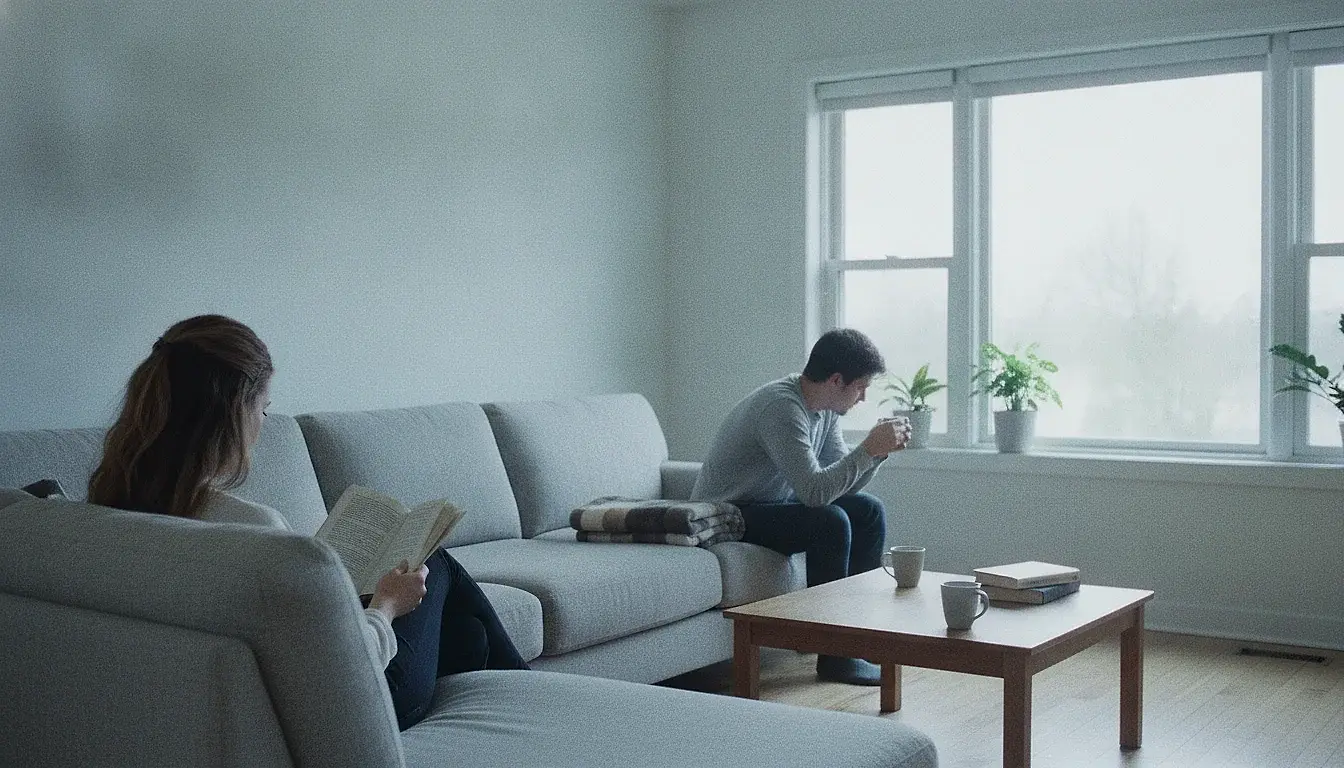
Avoidant attachment, described without the labels
Avoidant attachment is a term people arrive at from opposite directions. Some read it after a partner went quiet and never explained why. Others read it about themselves, after noticing that the moment a relationship gets serious is the moment they want a night alone.
Both readers are looking for the same thing: a description that holds up. This page gives one, in ordinary language, without turning the word into a verdict about anybody.
The term describes what a person does with closeness when closeness starts asking for something. It is not a personality type, not a diagnosis, and not a permanent setting. It is a pattern, and patterns are visible, repeatable and describable, which is the only reason writing about them is useful at all.
A boundary before we start: this site describes the avoidant pattern and nothing else. Other attachment styles, and comparisons between them, are not covered here.
What is avoidant attachment?
Avoidant attachment describes a way of handling closeness in which distance is the thing that steadies a person. Needs are downplayed rather than voiced, self-reliance is protected carefully, and connection is welcome right up to the point where it begins to require something. The term names behaviour under pressure, not a character.
The word avoidant on its own is plainer than it sounds. To be avoidant about something is to move away from it rather than toward it. Attached to the word attachment, it points at one specific thing being moved away from: the state of depending on another person and having that depend visibly.
In attachment theory, the label came out of watching how people respond when the person they rely on becomes uncertain. Some move toward. Some move away. The moving-away version is what later writing on adults calls avoidant attachment, and the more precise adult term for the version this site describes is dismissive avoidant.
Those two names cause a lot of confusion, so it is worth separating them plainly. Avoidant attachment is the broad term for the whole family. Dismissive avoidant is the specific adult pattern, the one where self-sufficiency is the main way of feeling safe. The dismissive-avoidant section is where that distinction gets its own page.
People asking what the pattern looks like in practice tend to want an example rather than a definition, so here is one. A relationship goes well. A conversation happens about moving in together, and it goes well too. Afterwards the replies get slower, the weekends fill up, and the person who was present becomes courteous. Nothing was said, and nothing broke.
What the definition does not include is any claim about feeling. A pattern describes what is done with closeness, not how much closeness is wanted. People who fit this description often want a relationship badly and find the wanting itself uncomfortable, which is a different sentence from not wanting one.
The term has also travelled a long way from where it started. Online it gets used as an accusation, a shorthand for someone who behaved badly, and occasionally as an identity people carry around like a blood type. Used that way it stops describing anything, which is why this site keeps the narrower sense: a pattern of behaviour around closeness, visible in what someone does when the pressure of a relationship rises.
What does avoidant attachment feel like from the inside?
From the inside, avoidant attachment rarely feels like avoiding anything. It feels like a preference for handling things alone, a sense that talking a feeling through makes it larger rather than smaller, and a physical relief when a demanding week ends and the flat is quiet. The distance is not experienced as distance. It is experienced as normal.
People describing themselves this way tend to report the same things. A question about feelings gets an honest answer later, once there has been time to work out what the answer is. An argument produces the urge to leave the room, not to raise the voice. Being needed is manageable; needing is not.
There is often a real pride in it, and the pride is not misplaced. Self-reliance works. It gets people through jobs, families and long stretches without much visible wobble, and it is widely admired, except inside a close relationship, where the same reflex reads as a door closing.
Needs do not disappear in this pattern; they get met privately. In practice, comfort comes from a long drive, a run, a night of work, an old friendship that asks nothing. None of that reads as coping from the outside, and from the inside it does not read as coping either. It reads as being fine, which is exactly why the pattern can run a long time without anyone naming it.
The uncomfortable part often arrives with warmth rather than with conflict. For instance, an evening goes well, something true gets said, and afterwards there is an unexplained wish to be somewhere else. That sequence surprises people who assume withdrawal follows a fight, and it is one of the things readers say they recognise straight away.
| Step | What happens inside | What it looks like from outside |
|---|---|---|
| Closeness rises | An evening lands well, or something honest gets said, or a plan starts including the future. | Things are going well. Often better than usual. |
| Discomfort registers | A vague pressure arrives, without a story attached to it yet. It is felt before it is understood. | Nothing visible. This is the part partners never see. |
| Distance opens | Reasons appear: a busy week, an early start, a need for a quiet night. They are true, and beside the point. | Replies get shorter, plans get vaguer, contact thins out. |
| Relief arrives | The pressure drops. Ordinary life resumes and the relationship stops occupying the foreground. | Silence, or a version of the person that seems switched down. |
| Re-approach becomes possible | With the pressure gone, warmth is available again, and the earlier retreat can look inexplicable in hindsight. | Sudden warmth, often arriving after the other person stopped waiting for it. |
That sequence has a name, and the mechanism behind it is the subject of its own section rather than something to restate here. The deactivation section covers what switches on between the second and third rows, why it looks sudden from the outside, and why it starts at the top of the closeness curve rather than the bottom.

What does avoidant attachment look like from the outside?
From the outside, avoidant attachment tends to be experienced as a warmth that arrives fully and then thins without an event to explain it. Partners describe an easy beginning, a good stretch, and then a quiet reduction: fewer plans, shorter answers, a person still present but somehow operating at a lower volume.
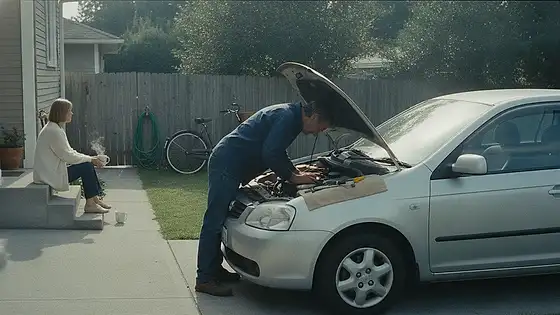
Care in this pattern tends to run through actions rather than statements. For example, the car gets fixed, the flight gets tracked, the difficult phone call gets handled without being asked. What is missing is the sentence that would make any of it legible, which is why the same relationship can read as devoted and remote in the same week.
Conflict is the other place it shows. Instead of escalation there is a flattening: agreement that arrives too fast, a subject that gets changed smoothly, a body still in the room and an attention that has left it. Nothing gets loud, and nothing gets resolved either.
The hardest part for the person on the other side is that none of it comes with information. A retreat without an explanation gets filled in by whoever is left holding it, and the story they fill it with tends to be about themselves. A question that keeps arriving here is a version of the same one: was that about me.
The reduction is rarely announced, and it is rarely permanent either. Contact can return without anything being resolved, which produces another recurring question here: whether a return means the problem passed or simply that the pressure did. That distinction runs through this site, and it is the reason we describe rhythms instead of predicting outcomes.
What are the traits of avoidant attachment?
The traits associated with avoidant attachment are descriptions of behaviour, not a list anyone passes or fails. They tend to appear together and to intensify under pressure, and each one has ordinary explanations that have nothing to do with attachment. What makes a pattern is the repetition, not the single instance.
Read the table below as a vocabulary rather than a checklist. Rows here will fit people who hold no such pattern at all, especially in a hard stretch, and recognising yourself in the whole column is still not the same as being assigned a category.
| Trait as described | What it looks like day to day | What it does not mean |
|---|---|---|
| High self-reliance | Problems get solved before they get mentioned. Help is accepted late, if at all. | That the person is incapable of depending on anyone, or unwilling to be relied on themselves. |
| Needs stated late | The request arrives after the resentment does, phrased as a preference rather than a need. | That there are no needs. It means the stating is expensive. |
| Discomfort with emotional questions | Direct questions about feelings get short, factual, or postponed answers. | That nothing is felt. Access to the answer is often genuinely slower. |
| Distance after closeness | A good evening is followed by a quieter stretch with no argument in between. | That the closeness was unwelcome or false. |
| Independence held tightly | Plans stay loose, keys and calendars stay separate, and merging life gets postponed. | That the relationship is unimportant. |
| Calm in conflict | Voices stay level, subjects get changed, and the argument ends without ending. | Agreement. It is more often the exit from the conversation. |
People ask whether these traits are bad. The honest answer is that they are adaptive and expensive at the same time. Every item in that first column is useful somewhere: in a crisis, in work that demands composure, in a childhood where needing things did not go well. The cost lands in one place only, which is inside relationships that require the pressure to be shared.
There is also a partial version of all this, and it is easy to land there rather than in the full description. Avoidant tendencies turn up in people who hold no such pattern: a preference for solving things alone, a lag before feelings can be put into words, a wish for a quiet evening after an intense one. Tendencies in a few situations are not the same thing as a pattern that organises a relationship, and treating them as identical is a recurring misreading of this whole vocabulary.
The behavioural side of this deserves more room than a table gives it, and the signs of the pattern are set out in full in the section on the style itself, including what a single behaviour does and does not establish.
Is avoidant attachment a diagnosis or a description?
Avoidant attachment is not a diagnosis, not a synonym for coldness, and not a permanent condition. It is a description of learned behaviour around closeness, which means it was learned in conditions that made it sensible and can shift in conditions that make something else sensible. Nothing about it is fixed by nature.
It is also not an explanation for everything a person does. Someone can hold this pattern and be unkind, or hold it and be extraordinarily kind, and the pattern predicts neither. Behaviour that harms another person stays that person’s responsibility regardless of which frame explains the distance around it.
And it is not something to assign to someone else. A partner who goes quiet may be exhausted, grieving, unwell, uninterested, or several of those at once. A word that fits a story is not evidence that the story is right, and there is no version of this vocabulary that turns into a verdict about the person you are with.
What this page does not do
A page defining a term is exactly where a description quietly turns into a label attached to a person. These are the lines we hold across the site.
- No quiz, no score, no verdict
- There is nothing here that assigns you or anyone else a style. Recognition happens while reading a description, and recognition can be wrong. We do not publish a test that pretends otherwise.
- No prevalence figures
- We publish no statistics about how common this pattern is, in any population or by gender. Our approved-facts file for the subject is empty, and a figure without a source we opened ourselves does not go on the page.
- No timelines
- You will not find how long a withdrawal lasts, how long before someone comes back, or how long anything takes. Such numbers circulate widely and none of them survive a look at where they came from.
- No scripts for changing another adult
- Nothing here is written to make someone stay, chase, miss you or open up. Descriptions of what tends to land and what tends to backfire are as far as this goes, and that limit is deliberate.
- No diagnosing, of you or of them
- This vocabulary describes behaviour around closeness. It does not identify a disorder, replace an assessment, or tell you what is happening inside another person's head.
Where to go from here
The rest of this site takes the pattern apart by situation, because the same description behaves very differently on an early date, in a marriage, and after a breakup. Each section below answers its own question rather than repeating this one.
The style itself covers the dismissive-avoidant term in detail: what distinguishes it from the broader label, which behaviours belong to it, and how the vocabulary drifted once it reached social media. It is the place to start if you are still working out whether the description fits at all.
Deactivation is the mechanism section, and it is the one this description keeps pointing back to. It covers what happens between the good evening and the quiet week, how the change reads from each side while it is running, and which responses to it make it last longer. Every other section links here rather than explaining it again.
Breakups describes what endings look like in this pattern: the calm separation, the abrupt cut-off people call a discard, and why feelings often surface long after the relationship stopped. It is written as a sequence, never as a calendar.
Dating is for the early stage, where the pattern is least visible and most consequential. The question it spends the most time on is the one that has no comfortable answer: whether what you are seeing is the pattern or straightforward disinterest.
If you are the partner is the practical section for the person on the other side. It covers what tends to help, what reliably backfires, and where self-help stops being the right tool.
Change is for the reader who recognised themselves. It describes what shifting this pattern involves, how uneven the movement is, and what people notice first, without promising an outcome or attaching a schedule to it.
If you want to know what this site is built on before you trust any of it, the sources page lists the material behind these descriptions and states plainly where the writing rests on how people describe their own experience rather than on research.
Where this page stops
This page describes a pattern of behaviour. It cannot tell you whether the pattern is yours, whether it is your partner’s, or what caused it in either case, and it does not distinguish an attachment description from anything clinical, because those are separate frames answering separate questions.
Where the pattern comes from is covered in the section on causes, and that page keeps the same limits: it describes how this way of relating is thought to be learned, and it does not name a diagnosis or hand out blame.
If distance in your relationship is coming with something heavier, or if reading a description like this one is the closest you have come to asking a much bigger question about how you are doing, that question belongs with a therapist or a doctor who can ask you the follow-ups a page cannot. We describe patterns. We do not assess people, and we would rather say so than blur the line.